Anyone who has been talking for more than a couple years can tell you the importance of clear communication. Sometimes the words or phrases that we take for granted are not as clear as we might hope them to be. In this article, Dan Buckley, discusses how "Best Efforts" is interpreted in different ways and invites you to a conversation about how we can better communicate and align the meaning of terms we use across our industry.

When your line manager asks for your report for ‘End of Day’, what is the latest possible moment they need it? Even within one team I asked, we had people that thought everything between ‘early afternoon so that I can action before 5pm’ and ‘any time is fine as long as its in my inbox when I get in tomorrow.’ Everyone is subconsciously constructing a layer of idioms on top of our everyday language that we struggle to notice until they fail us.
Having clear communication is important to effectively managing any project, or really, any part of our lives. It's particularly important in the dynamic world of market research.
We often use the term "best efforts" to describe a potential recruit. However, what exactly does “best efforts” mean and how can we navigate the diverse perceptions surrounding it? To get an idea of how the term “best efforts” is understood we conducted an informal poll of what ‘Best efforts’ meant on Linked In. We asked:
When you hear the terms ‘Best Efforts’ what does this mean to you?
If it is at all possible, I’ll do it
No promises or commitment
I can't do it
Something else
Each option was meant to have a similar content or literal meaning with a different tone or implication. We had 47 people from across the Market Research industry respond and the results were interesting! We divided the responses into 3 categories based on the company where they were currently working: Pharma/device company, Research/Consultancy, or Fieldwork.
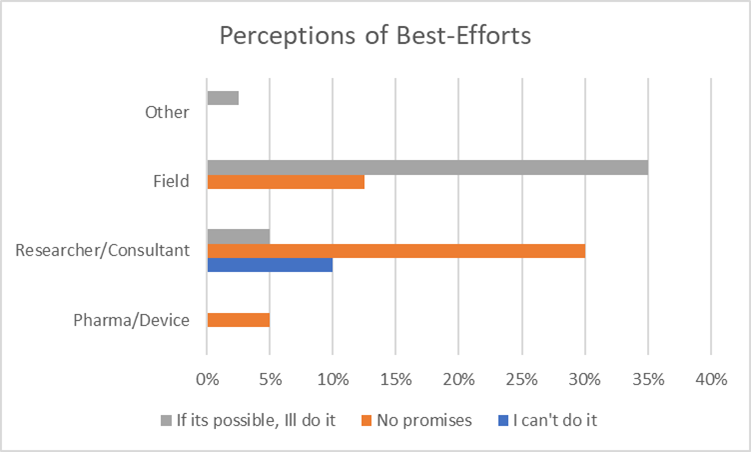
Intriguingly, there was a stark contrast in how ‘best efforts’ is perceived by different sections of the MR industry. For data geeks: X2 (N = 47) = 18.3, p = .01). Those in Fieldwork generally understood this to mean ‘if it’s possible we’ll do it,’ however those in Research and/or Consulting roles have a perception of ‘no promises’ or that it can’t, in fact, be done.
Admittedly there are some major limitations to our sampling:
Yet, this could indicate that there is significant gap between how field communicate what the chances of success will be, and the expectations of the research and consulting teams. The impact could be a field or research team not winning a study, offering a too low sample or unintentionally underselling their hard work, due to a simple misalignment of terms.
How do we close this gap? These hurdles underscore the importance of transparent communication and managing client expectations. Could it be as simple as outlining a solid recruitment strategy specific to project quotas, with timelines and step by step process between the teams?
If anything, this simple poll has highlighted the need to discuss this further within the industry to align the terms we are using on a regular basis.
If you would like to continue exploring how our industry is unknowingly speaking different languages with me, let me know and join the conversation!
Email [email protected] or use our contact us form below for bids, questions or further information.